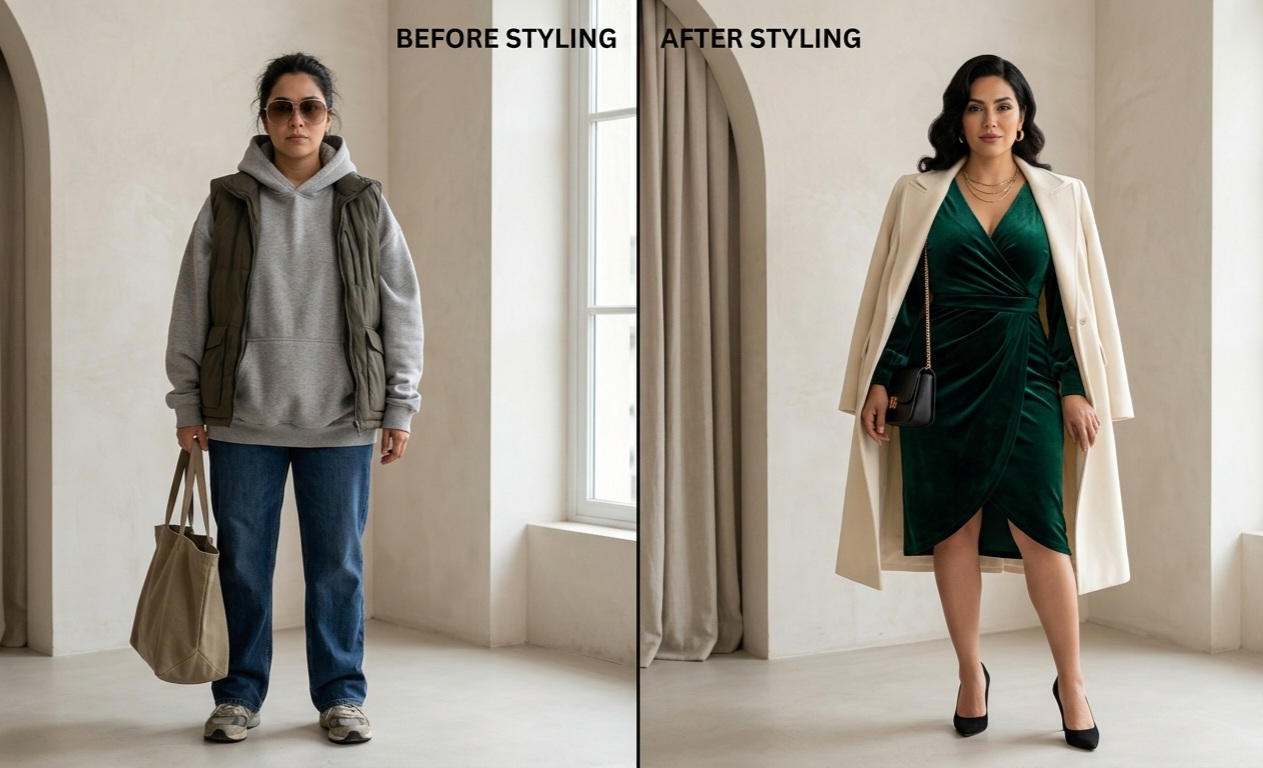
HOURGLASS BODY TYPE: COMPLETE STYLING & GLOW-UP GUIDE FOR WOMEN
Understanding Balance in an Already Balanced Body
The hourglass body type is often described as “naturally balanced,” but that does not mean styling it is automatically effortless.
Many women with an hourglass figure search for answers like how to dress an hourglass body, what clothes suit an hourglass shape, or why certain outfits make their proportions look heavier or overly defined. The confusion is not about lack of options. It is about understanding control.
An hourglass body shape is defined by a balanced bust and hips with a naturally defined waist. This creates a strong structure, which means even small styling choices can either enhance that balance or disrupt it.
With an hourglass body, the goal is not to create shape. It is to maintain it without exaggerating it.
This is where most women go wrong. Outfits that are too tight can over-emphasize curves and feel restrictive. Oversized clothing can hide the natural structure and make the body appear heavier. Even small details like seam placement, fabric thickness, or where a garment sits on the waist can shift the entire look.
I have seen women feel uncomfortable in outfits that were technically “right” for their body type, simply because the balance was pushed too far in one direction.
When styling is adjusted correctly, the difference is immediate. The body looks proportionate without effort. The waist is defined without pressure. The overall appearance feels composed rather than constructed.
Hourglass styling is about control, not correction.
This section is designed to help you understand how to work with your proportions rather than against them. From dresses and tops to structure, fabric, and placement, each element is chosen based on how it supports balance instead of distorting it.
You do not need to change your body. You only need to understand how to let it remain in proportion.If you prefer not to analyse every small choice each time, you can also explore carefully curated selections
When that happens, styling becomes simple, consistent, and effortless.
What Is an Hourglass Body?
The hourglass body is defined by balanced proportions where the bust and hips share nearly identical width, paired with a naturally narrower, well-defined waist that creates a sculpted S-shaped silhouette. This body type often maintains its curvature even with weight fluctuations, because fat tends to distribute evenly across the bust, hips, and thighs while the waist remains relatively small. Scientifically, this shape often results from a balanced interaction of estrogen and testosterone distribution, leading to a naturally feminine fat patterning that supports softness while still allowing strong musculature. The shoulders are softly rounded, the hips full, and the torso appears naturally proportional without hard lines or angles. Understanding this body type is essential because its strengths lie in its curves, but these same curves can be easily hidden or distorted when clothing is not chosen strategically.
Strengths of the Hourglass Body
The hourglass figure is powerful because it embodies both symmetry and femininity. When dressed correctly, the body looks sculpted, balanced, and effortlessly attractive without needing extreme styling. The waist acts as a visual anchor, drawing the eye inward and accentuating the smooth outward curves of the bust and hips. This gives hourglass individuals a naturally dramatic silhouette that can appear sensual or elegant depending on styling. The balanced proportions mean that most fitted clothing drapes beautifully, and fabrics follow the body without awkward volume. In photography and in motion, the hourglass silhouette maintains a strong presence because its curves create dynamic lines that amplify posture and gesture. This body type also holds muscle definition well; the legs and arms look toned quickly, and the torso responds well to core strengthening. These strengths make the hourglass one of the most adaptable and striking body shapes when styled with intention and precision.
Challenges of the Hourglass Body
Despite its advantages, the hourglass figure can face specific issues when it comes to fashion and comfort. Many clothes in the market are designed for straighter body types, causing gaps at the waist, tightness in the bust, or flattening at the hips. Ill-fitting clothing can easily ruin the natural curvature, making the body appear boxy or heavier than it actually is. The bust can overwhelm the frame if unsupported; the hips can appear too wide if fabric adds unnecessary volume; and the waist can disappear entirely under straight cuts. Curves often cause tops to ride up and skirts to shift, so the hourglass figure needs proportion-considered garments that respect shape rather than fight it. Understanding these challenges allows for smarter choices that highlight the strengths without causing imbalance or distortion.
What to Accentuate
The key to dressing an hourglass body is keeping focus on the waist, maintaining clean vertical flow, and supporting the bust without exaggerating it. The goal is not to create curves, you already have them but to shape them elegantly so the silhouette appears balanced rather than overwhelming. Clothing that gently hugs the waist, follows the natural hip curve, and supports the chest will always create the most harmonious look. Accentuating the waist through well-placed seams, belts, and cuts showcases the hourglass identity while allowing freedom of expression in style aesthetics, whether minimalistic, glamorous, or soft feminine.
What NOT to Accentuate
Avoid emphasizing elements that throw off proportion, such as excessive padding, boxy structures, or shapeless fabrics that add width to the torso or hips. Avoid anything that hides the waist or visually enlarges the bust. Wide, loose, or stiff materials often blur your natural outline and turn your figure into a rectangle. Anything that removes waist definition or adds volume in the wrong areas works directly against the hourglass harmony.
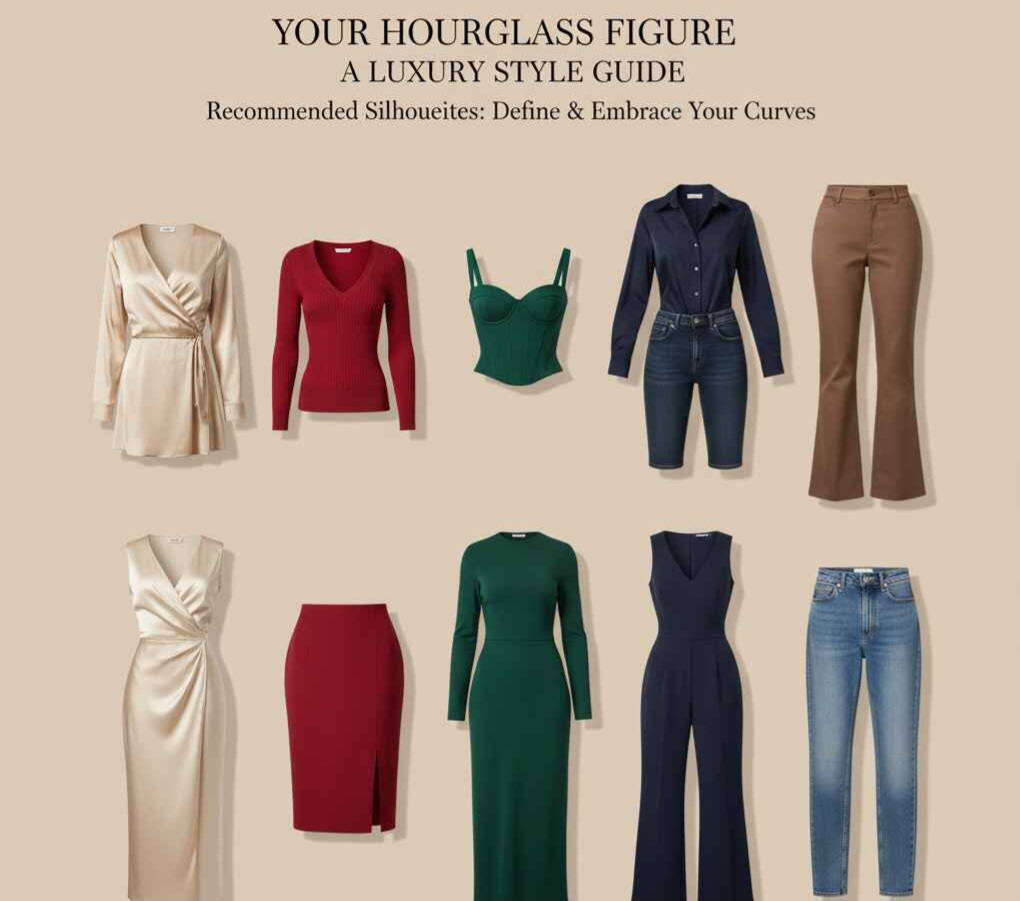
TOPS FOR THE HOURGLASS BODY
Tops to Wear: Fitted tops, wrap tops, peplum styles, structured shirts that taper inward, and knit fabrics that mold to the body all work exceptionally well. V-necks, scoop necks, sweetheart necklines, and square necks elongate the torso and balance the bust without making it dominant. Tops that cinch at the waist, or are slightly cropped to meet high-waisted bottoms, maintain proportional harmony. Fabric weight is also important: medium-weight materials drape beautifully without adding bulk.
Tops NOT to Wear: Boxy t-shirts, oversized tops, shapeless blouses, and high, closed necklines like mock necks and turtlenecks can make the bust appear disproportionately large and flatten the waist. Stiff fabrics, straight-cut button-downs, and tops that hang from the bust downwards distort the true shape of the body. Avoid tops with excessive ruffles, oversized shoulders, or heavy embellishments across the chest.
BOTTOMS FOR THE HOURGLASS BODY
Bottoms to Wear: High-waisted jeans, tailored trousers, pencil skirts, mermaid skirts, and A-line skirts gently skim the hips and celebrate the hourglass proportion. Pants with structured waistbands and a slight stretch allow the fabric to mold smoothly without gapping at the waist. Wide-leg trousers can also look spectacular when fitted at the top, creating a lean vertical line that balances curves. Skirts that hug the hips and taper slightly at the knees emphasize the elegant hourglass silhouette.
Bottoms NOT to Wear: Low-rise jeans distort the waist-to-hip ratio by visually lowering the widest part of the body, causing the figure to appear heavier and shorter. Straight-cut pants, excessively baggy bottoms, and styles with bulk at the hips like cargo pockets or pleats can widen the lower body unnecessarily. Stiff materials that do not stretch or accommodate curves often cause awkward pulling at the hip area. Avoid anything that eliminates the natural curve by flattening the hips or creating square shapes.
DRESSES FOR THE HOURGLASS BODY
Dresses to Wear: Wrap dresses, bodycon dresses, tailored sheath dresses, fit-and-flare dresses, and dresses with structured bust areas look stunning. Fabrics that glide over the body, such as jersey, silk blends, and quality knits, highlight curves without clinging excessively. Dresses with seaming, paneling, and strategic tailoring enhance natural proportions, while midi lengths add sophistication and elongation. Off-shoulder and sweetheart-neck dresses are excellent choices for showcasing the upper body while maintaining balance.
Dresses NOT to Wear: Shift dresses, boxy tunics, straight-cut slip dresses, and anything without waist definition visually flatten the silhouette and make the body appear wider than it is. Dresses that are overly loose or made from stiff fabrics behave poorly on curves, creating unnatural lines. High-neck, unshaped dresses can make the bust feel heavy and disproportionate. Avoid dresses that add bulk around the hips or waist.
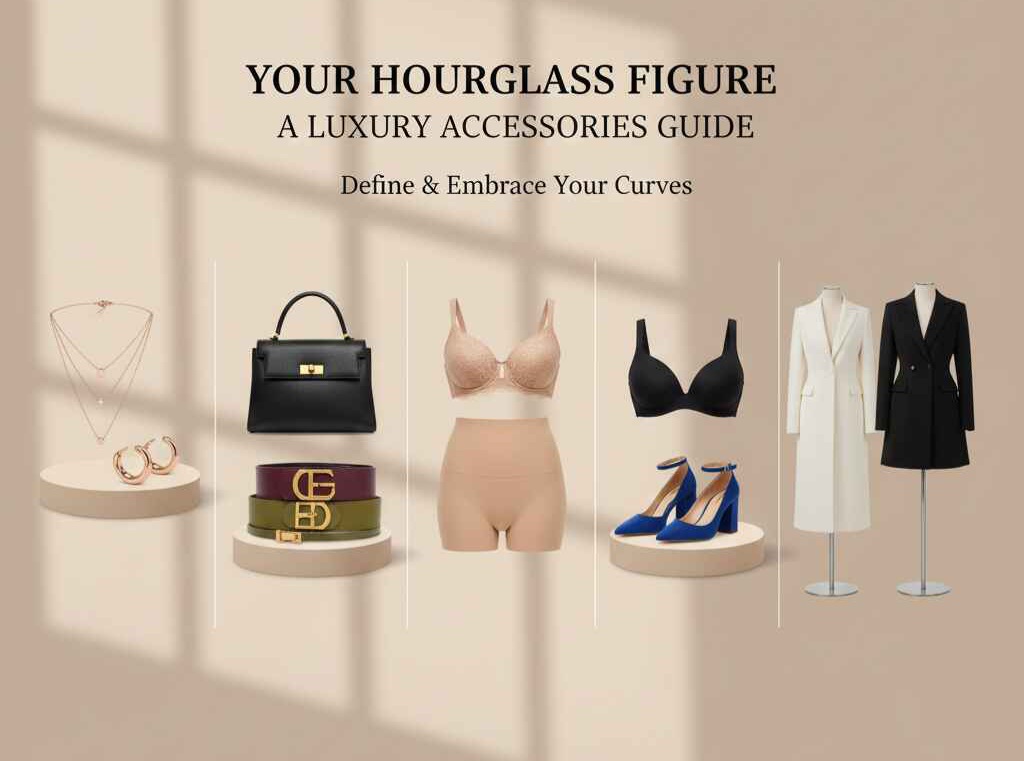
INNERWEAR FOR THE HOURGLASS BODY
Innerwear to Wear: Bras that lift without compressing the bust-balconette, demi-cup, and underwired contour bras ,keep the chest in proportion with shoulders and hips. High-waisted underwear, seamless panties, and sculpting briefs enhance the natural waistline. Light-to-medium shapewear smooths the silhouette without reducing curves. Bodysuits with waist emphasis shape beautifully under fitted clothing.
Innerwear NOT to Wear: Minimizer bras flatten the bust. Cheap or overly tight sports bras compress the torso, creating a boxy look. Low-rise underwear or panties with harsh elastic cut into the hips and disrupt the smooth hourglass line. Thick, bulky padding in bras adds unnecessary volume. Avoid restrictive or ill-fitting shapewear that compresses the hips or waist uncomfortably.
OUTERWEAR FOR THE HOURGLASS BODY
Outerwear to Wear: Belted coats, wrap coats, fitted trench coats, structured leather jackets, and tailored blazers enhance the hourglass shape. Long-line coats follow the body to elongate the silhouette. Cropped jackets highlight the waist beautifully when paired with high-waisted bottoms. Slightly structured fabrics keep the look polished without adding bulk.
Outerwear NOT to Wear: Oversized outerwear, boxy jackets, straight coats, stiff puffers, and square-cut blazers remove waist definition and visually widen the torso. Shapeless trench coats destroy proportional harmony. Avoid high-buttoned coats that compress the bust and shorten the torso.
ACCESSORIES FOR THE HOURGLASS BODY
Bags to Use: Structured medium handbags, top-handle bags, and shoulder bags that sit slightly above the hip complement curves. Clean lines and balanced proportions help maintain symmetry. Sleek silhouettes look refined and elevate the softness of the hourglass.
Bags NOT to Use: Oversized totes, extra-large slouchy bags, extremely small mini-bags, or anything falling at the widest part of the hip interrupts visual balance. Bags with excessive bulk, heavy hardware, or exaggerated shapes disturb the harmony.
Belts to Use: Medium-width or slightly wide belts that cinch at the natural waist highlight the narrowest point, enhancing the silhouette. Leather belts, structured belts, and belts with clean buckles define the waist without adding weight.
Belts NOT to Use: Very thin belts look disproportional. Very thick belts covering too much torso create heaviness. Belts on the hips rather than waist widen the lower body unnecessarily.
Shoes to Wear: Pointed-toe heels, ankle-length boots with fitted shafts, sleek pumps, strappy heels, and minimalist sandals elongate the legs and maintain balance. Refined shoes keep attention on elegant curves.
Shoes NOT to Wear: Chunky sneakers, heavy platforms, thick combat boots, and shoes with thick straps create visual weight. Avoid shoes with horizontal cuts that stop abruptly on the ankle.
Jewelry to Use: Medium-scale pieces with elegant curves oval hoops, teardrop earrings, softly rounded pendants, and delicate layered necklaces enhance facial symmetry. Bracelets and rings with gently rounded shapes add refinement. Jewelry framing the collarbone highlights the balanced upper body.
Jewelry NOT to Use: Extremely oversized jewelry, large geometric pieces, harsh angular designs, very long earrings, very wide chokers, and thick blocky bracelets can overpower the hourglass balance.
Real Styling Experience – Hourglass Body Shape
In real styling work, the hourglass body is one of the most misunderstood shapes. From the outside, it is often seen as the easiest to dress. In reality, I have seen it go wrong more often than expected, not because of the body, but because of how easily its balance gets disturbed.
I remember working with a woman who had a naturally defined waist, proportionate bust and hips, everything that visually creates harmony. Yet every outfit she wore made her feel slightly uncomfortable. She kept adjusting her clothes, pulling them, fixing them, as if something was never sitting right.
When I looked at her wardrobe, the pattern was clear. Most of her clothes were either too loose or too structured in the wrong way. Boxy tops, straight dresses, oversized shirts. She thought she was simplifying her style, but what she was actually doing was removing the very balance that made her body work.
We did not change her entire wardrobe. We only changed how her clothes interacted with her waist.
A softly fitted dress. A wrap silhouette. A belt placed exactly where her natural waist existed, not higher, not lower. The shift was immediate. She stopped adjusting herself. Her body looked more aligned, more composed, without trying harder.
That is the truth about hourglass styling. It is not about tight clothes. It is about respecting proportion.
Another situation I often see is over-emphasis. A client once came in wearing very tight clothing thinking it would highlight her curves. Instead, the outfit looked heavy and over-defined. The structure became too forced.
We shifted to fabrics that followed her shape instead of clinging to it. Clean lines. Slight drape. Defined but not restrictive. The result was far more refined. The same body, but now it looked effortless instead of intentional.
This balance is what most people miss.
Hourglass styling is not about showing more. It is about allowing your natural structure to speak without interruption.
Where Most Women Go Wrong
One of the most common mistakes I see is hiding the waist. Oversized clothing may feel comfortable, but on an hourglass body, it removes definition and creates visual width. The body starts to look heavier than it actually is.
Another mistake is shifting the waistline. High-waisted pieces that sit too high or belts placed incorrectly can distort proportions. The body loses its natural symmetry.
I have also seen women rely heavily on stretch fabrics thinking they will “adjust better.” In reality, overly stretchy fabrics often cling in the wrong areas and lose structure, which affects the overall finish.
And then there is the issue of imbalance. Heavy tops with light bottoms, or overly detailed lower halves with minimal upper structure. These combinations subtly break the natural proportion the hourglass body already has.
Professional Do and Do Not Guidance
Do define your natural waist. This is your strongest visual point. Even soft definition creates a powerful difference.
Do choose silhouettes that follow your body rather than fight it. Wrap dresses, fitted tops, structured yet flexible fabrics work beautifully.
Do maintain balance between upper and lower body. Your strength is symmetry, keep it consistent.
Do choose belts that enhance, not cut. Medium-width belts placed at the natural waist work best.
Do pay attention to fabric movement. Slight drape is more flattering than stiffness.
Do not hide your waist completely with oversized clothing. It removes your natural advantage.
Do not over-tighten outfits. Over-definition creates heaviness instead of elegance.
Do not use very stiff fabrics that sit away from the body. They break your natural lines.
Do not overload one part of your outfit. Keep visual weight balanced.
Do not ignore small details like sleeve length, waist placement, and fabric fall. These define the final outcome.
Practical Wardrobe Strategy
In daily life, simplicity works best when it is intentional.
For everyday wear, choose tops that gently follow your shape instead of hanging straight. Even a slight inward cut at the waist makes a visible difference.
Dresses should feel like they move with you. If you feel restricted or if the fabric pulls, it is not the right fit. If it hangs without shape, it is also not right. The correct piece will feel balanced without effort.
Belts are one of the easiest tools to correct an outfit instantly. Even a simple dress can look completely different when the waist is defined correctly.
Footwear should not feel disconnected. Clean, structured shoes help maintain the overall line of the outfit. Extremely bulky footwear can sometimes interrupt that flow.
Jewelry should follow your neckline and not overpower your proportions. Medium-scale pieces tend to work better than extremes.
When shopping, always ask one question. Does this respect my waist and my balance. If the answer is yes, it will most likely work.
Frequently Asked Questions
1. Do I always have to wear fitted clothes?
Not at all. What your body needs is recognition of its natural shape, not restriction. I have styled women who believed tight clothing was the only way to “show” their hourglass figure, but it often made them feel overexposed and uncomfortable. When we shifted to softly structured pieces that followed the body instead of gripping it, they felt more elegant, more in control, and far more confident.
2. Can I wear oversized outfits?
Yes, but they need intention. Oversized pieces without structure tend to hide your natural balance. I once worked with a client who loved oversized shirts, but she felt invisible in them. We kept the oversized shirt, added a soft front tuck and a defined bottom, and suddenly her shape returned without losing comfort. It is not about removing volume, it is about guiding it.
3. Where exactly should my belt sit?
At your natural waist, the point where your body curves in the most. This is your strongest visual anchor. When placed correctly, everything above and below falls into harmony. When misplaced, even a beautiful outfit can feel slightly off.
4. Why do some dresses make me look heavier?
It is rarely about your body. It is about the dress ignoring your waist or adding unnecessary volume in one area. I have seen women blame themselves when the real issue was poor garment structure. The moment we reintroduced waist definition, the same person looked lighter, more proportioned, and more at ease.
5. Are bodycon dresses good for hourglass?
They can be, but only when the fabric supports you. Cheap or overly thin fabrics tend to cling unevenly and create visual tension. A well-made bodycon that holds its shape enhances you. The difference is not the style, it is the construction.
6. What type of tops work best?
Wrap tops, gently fitted silhouettes, and anything that acknowledges your waist without forcing it. The goal is to echo your natural lines, not redraw them.
7. Can I wear straight-cut outfits?
Yes, but they should still respect your proportions. Even a slight taper or a soft tuck can bring back your natural balance. Completely straight silhouettes often erase what makes your shape harmonious.
8. What fabrics should I avoid?
Very stiff fabrics that stand away from the body and overly clingy ones that exaggerate every line. You need fabrics that move with you, not against you. I always tell clients to move, sit, and walk in an outfit before deciding. Your body will tell you the truth.
9. How do I balance heavy bust and hips?
By distributing attention. If one area has detail, the other should feel visually supported. I once styled a woman who wore heavily detailed tops with plain bottoms, and it made her feel top-heavy. When we balanced both halves, her entire presence felt calmer and more aligned.
10. Are belts necessary?
No, but they are powerful. Think of them as a tool, not a rule. Sometimes the garment already defines your waist beautifully, and adding a belt would only interrupt that flow.
11. Can I wear high-waisted bottoms?
Yes, they often work beautifully when they align with your natural waist. The key is comfort and placement. If you feel restricted or constantly adjusting, it is not the right fit.
12. Why do oversized blazers look off on me?
Because they often erase your waist completely. I have seen clients feel “lost” inside structured oversized blazers. The solution was not to avoid blazers, but to choose ones that taper slightly or allow subtle shaping.
13. What neckline suits me best?
Open necklines like V, scoop, or soft square create space and balance your upper body. They prevent your bust area from feeling crowded and keep the overall look refined.
14. Can I wear layers?
Yes, layering can look incredibly elegant on you. Just ensure at least one layer respects your waist. Without that, layers can feel heavy and disconnected.
15. How do I know if something fits correctly?
You stop adjusting it. That is the simplest and most honest answer. When something truly works, your body relaxes into it.
16. Are jumpsuits good for hourglass?
They can be stunning, especially when they include waist definition. A well-cut jumpsuit can highlight your proportions effortlessly.
17. What about skirts?
Pencil, A-line, and wrap skirts all work beautifully when balanced with the right top. The key is maintaining proportion between your upper and lower body.
18. Can I wear crop tops?
Yes, especially when paired with high-waisted bottoms that meet your natural waist. This creates a clean, balanced line rather than a broken silhouette.
19. Do prints affect my shape?
Very much. Uneven or overly concentrated prints can disrupt your natural symmetry. Balanced prints enhance it.
20. What is the biggest styling rule?
Never ignore your waist and natural proportion. Everything comes back to this.
21. Can I wear loose dresses?
Yes, but they should have some structure or the ability to be shaped. Completely shapeless dresses often hide your strongest feature.
22. What kind of jackets suit me?
Tailored or softly fitted jackets that follow your natural line. They bring instant polish without effort.
23. Why do some outfits feel uncomfortable visually?
Because they are not aligned with your proportions. Even if they are trendy or expensive, your body senses the imbalance.
24. Can I experiment with trends?
Absolutely. Trends are meant to be explored. Just filter them through your body’s natural structure so they work for you, not against you.
25. Do I need a complete wardrobe change?
No. Most of the time, small adjustments create the biggest difference. A tuck, a belt, a better fit, these change everything.
26. What colors work best?
For your body shape, structure matters more than color. Color enhances, but proportion defines.
27. How do I look more polished instantly?
Acknowledge your waist and balance your outfit. This single step often transforms your entire appearance.
28. Can I wear belts on every outfit?
No. Overusing them can feel forced. Use them when they enhance, not when they interrupt.
29. What should I focus on while shopping?
Fit, waist placement, and how the fabric behaves when you move. Do not just look at it on the hanger. Experience it on your body.
30. What is the final takeaway?
Your body already holds a natural harmony that many try to create artificially. Your role is not to change it, but to respect it. When your clothing follows your structure instead of fighting it, everything begins to feel effortless, and that is where true elegance begins.
Final Notes on Styling the Hourglass Body
The hourglass figure’s goal is to highlight balanced curves, accentuate the waist, and maintain symmetry between bust and hips. Through fitted garments, wrap styles, structured layering, supportive innerwear, and complementary accessories, the hourglass silhouette appears elegant, sculpted, and harmonious. Clothing, belts, shoes, and jewelry should guide the eye along the curves, enhancing confidence, poise, and refined style.
More Guides You Might need
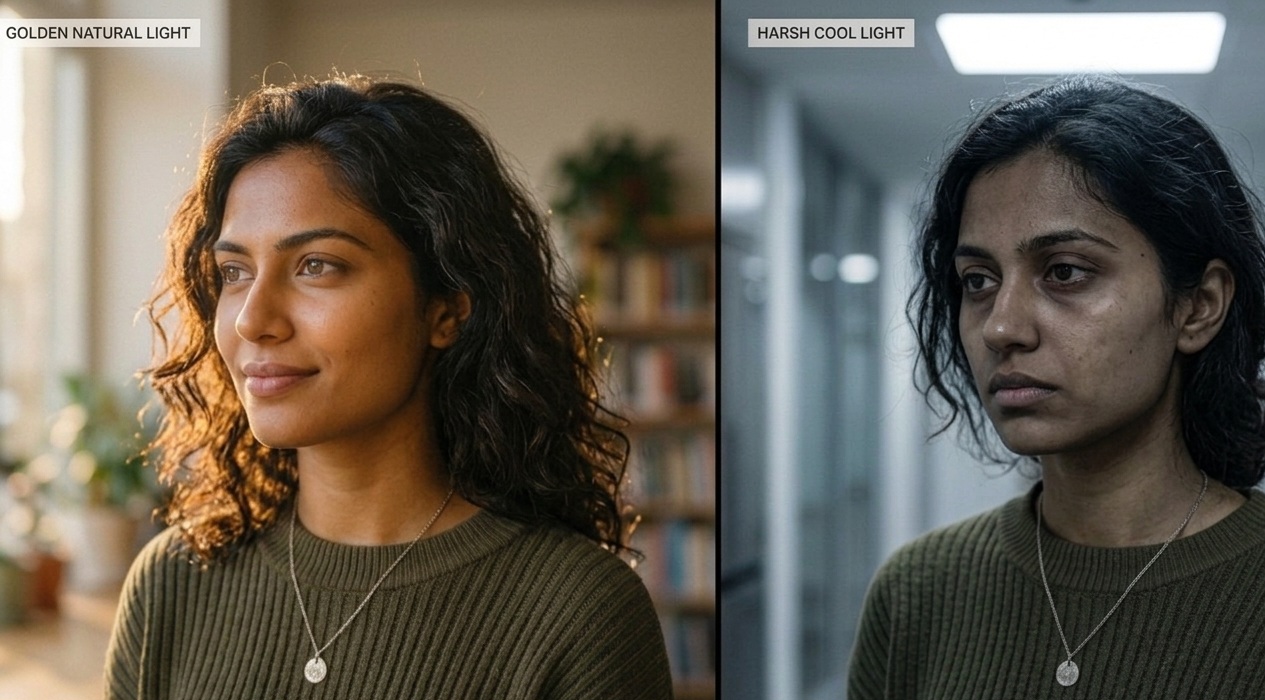
Why You Look Better in Some Lighting and Worse in Others
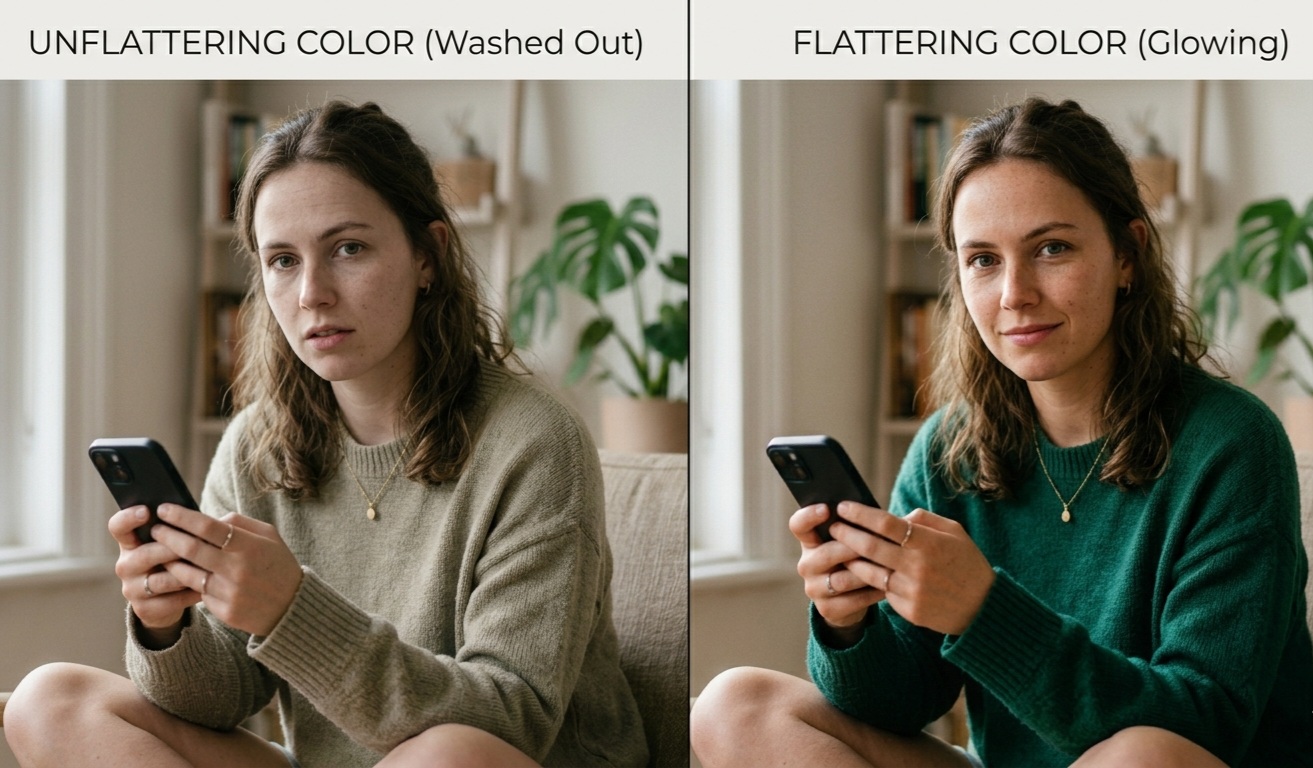
Why Do I Look Washed Out in Photos and How to Fix It

Why Do Bad People Seem to Win in Life?

Why Don’t I Feel Happy About My Pregnancy All the Time?

Why Does My Mind Feel So Heavy During My Period?
How to Dress Better Without Buying New Clothes

Is My Phone Making Me Dumb Every Day?

Why do I look bad in photos ? ( and what's the solution )
© 2026 Femmemalist™. All rights reserved.